
Products
Solutions
Technical Information
Motor Sizing
Downloads
Contact Us
Vacuum Rated (Vacuum degree 10-5 to 10-4 Pa
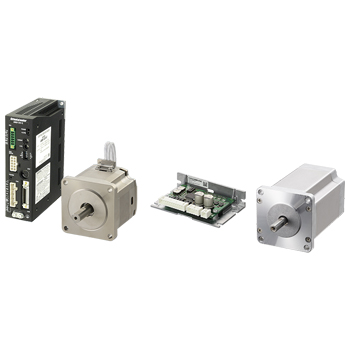
Vacuum Rated Stepper Motors
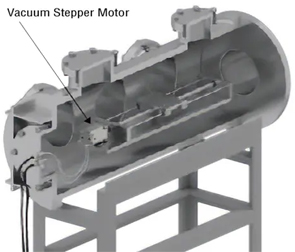
Vacuum rated motors can be installed in a vacuum environment to increase efficiency, reduce heat generation, and miniaturize overall design.
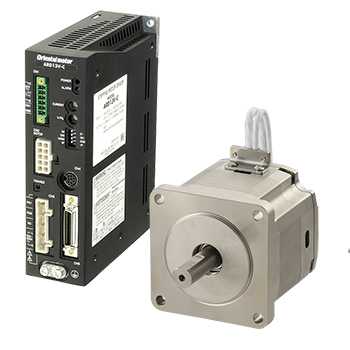
αSTEP AR Series motors reduce costs and eliminate the need for a sensor for position confirmation in a vacuum environment, while maintaining precise positioning and the high-reliability of closed-loop control. αSTEP AR Series features Current Control Mode to further reduce heat generation and magnetic noise under low-load conditions.
The PK Series vacuum rated stepper motors are 5-phase open-loop motors engineered for precise positioning inside vacuum enclosures, eliminating the need for a motion transfer device and enabling more compact system designs.
αSTEP AR Series
|
PK Series
|
Stepper Motor Lineup
Power Supply Input |
Series Name |
Basic Step Angle [°] |
Vacuum Degree [Pa] |
Frame Size [mm] |
Mass [kg] |
|||
|---|---|---|---|---|---|---|---|---|
28 |
42 |
60 |
85 |
|||||
AC |
αSTEP AR Series Vacuum Rated* |
0.36 |
10-5 |
- |
• |
• |
• |
0.47~1.9 |
DC |
• |
• |
• |
• |
0.2~3 | |||
DC |
5-Phase PK Series Vacuum Rated/CVD Series Driver |
0.72 |
10-4 |
- |
• |
• |
- |
0.21~1.3 |
10-5 |
• |
- |
- |
- |
0.11~0.2 |
|||
*Connection cables are available for αSTEP AR Series Vacuum Rated
Features and Structure of Vacuum Rated Motor
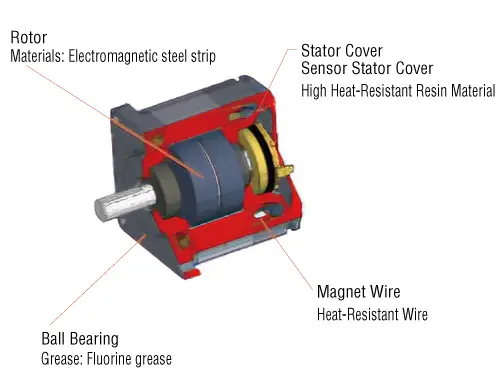
- To reduce gas emissions, the motor case is made of aluminum and stainless steel, and the surface is not painted. In addition, vacuum grease is also used for the bearings.
- There is no need to worry about contaminating the vacuum environment, as the emitted gases are the same components found in a normal, clean environment.
- Heat-resistant winding is used to withstand the temperature of the baking process.
Advantages of Vacuum Type Motors
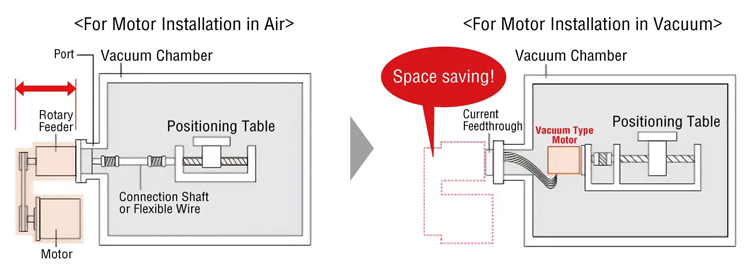
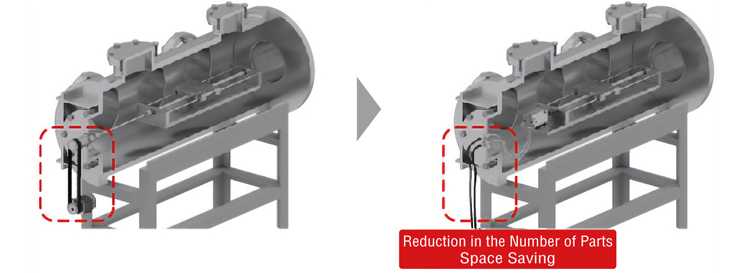
Miniaturizing Equipment and Increasing Design Flexibility
When a motor is installed in the air, the equipment becomes large due to the use of a rotating induction machine. The vacuum type allows the motor to be installed in a vacuum environment, meaning the equipment can be miniaturized. In addition, the αSTEP AR Series eliminates the need for a sensor for position confirmation, which contributes to cost reduction.
With the αSTEP AR Series, Position Monitoring Without an Encoder is Possible
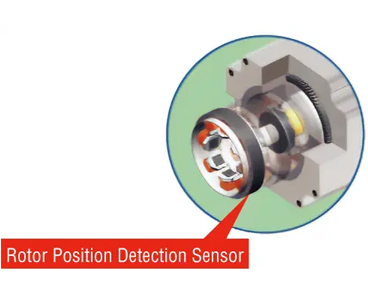
The low-loss αSTEP AR Series is ideal for analysis and processing applications in a vacuum environment. The αSTEP AR Series monitors motor information through closed loop control and is equipped with various alarm output functions. Expensive vacuum-compatible encoders are no longer needed.
Realization of Various Movements in a Vacuum
They are used in various applications, including semiconductor manufacturing equipment and measuring instruments such as electron microscopes.
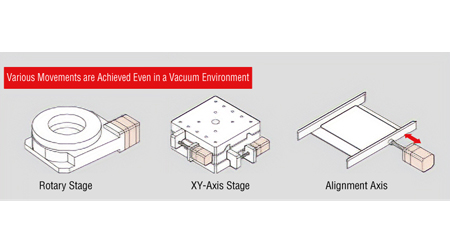
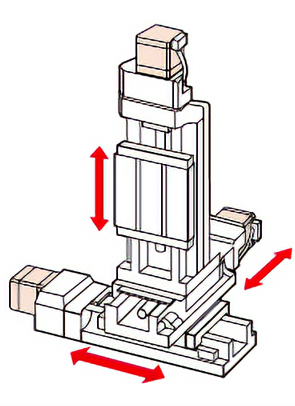
Vacuum type motors can be used for multi-axis stages in a vacuum environment, which is difficult to design with rotating induction machines. Multiple axes can be combined in a vacuum to achieve more complex movements.
Helping to Maintain the Quality of Vacuum Environments
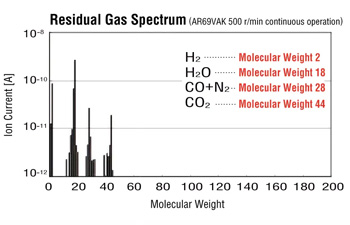
Designed to Reduce Gas Emissions
To reduce the gas emissions, the surface of the motor is not painted, and vacuum grease is used for the bearings. The main residual gases will be the same as those found in a normal, clean environment, so there is no need to worry about contamination of the vacuum chamber.
Maintain the Vacuum Pressure by Suppressing Temperature Rise
Normally, as the motor current value increases, the vacuum pressure increases. This is due to the increase in motor temperature and increased evaporation of water, mainly from the windings and resin material. To keep the vacuum pressure low, it is important to keep the motor temperature low.
Motor current value increases → Motor temperature rises → Water evaporates from motor parts → Vacuum pressure rises
Motor Current - Vacuum Pressure Characteristics (Normal mode)
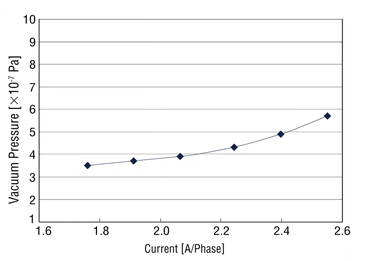
The αSTEP AR Series has a function to adjust the motor current according to the magnitude of the load torque (CC mode). When used in CC mode, both the motor temperature and vacuum pressure can be kept low.
The figure below shows the rotation speed - temperature characteristics during continuous operation and duty cycle operation (intermittent operation).
Rotation Speed - Temperature Characteristics (CC mode)
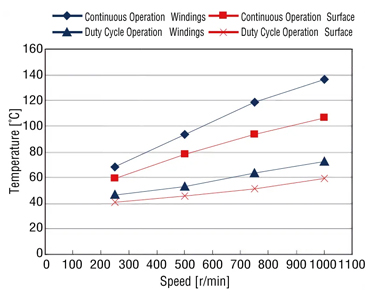
- Even during continuous operation when the temperature tends to be high, if the operating speed is 900 r/min max., the outer coating temperature will not exceed 100 °C.
- The external surface temperature during 500 r/min duty cycle operation is 46 °C in CC mode and 80 °C in normal mode, as compared to each mode. The temperature is 34 °C lower in CC mode.
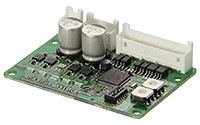
CVD 5-Phase Drivers
We're Here to Help

Business Hours:
Monday to Friday
8:30am EST to 5:00pm PST
Technical Support:
1-800-468-3982
Robot Support:
1-800-443-0775
Inside Sales Support:
1-800-448-6935
Customer Service:
1-800-418-7903


